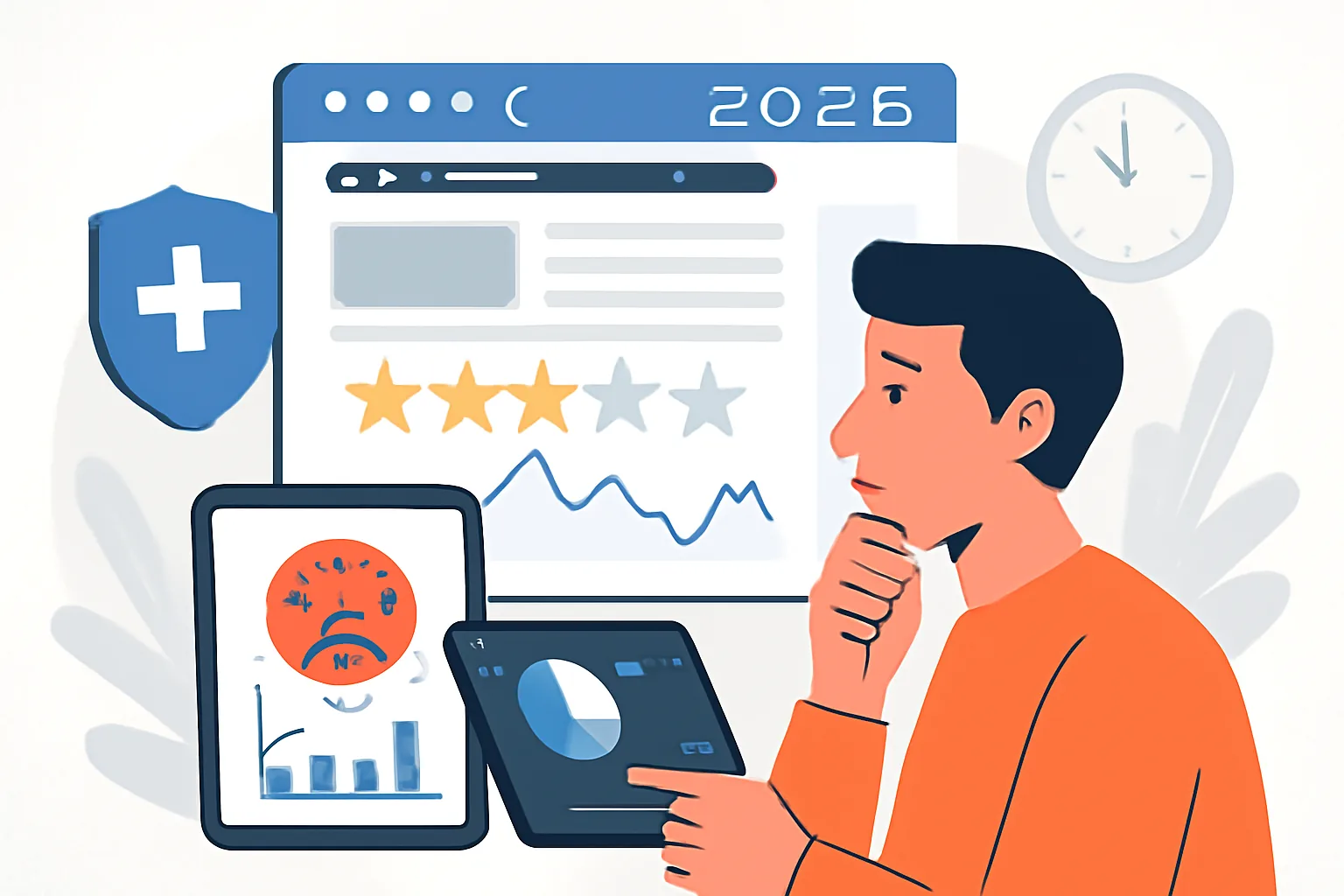
Why reputation monitoring became more important in 2026
In 2026, reputation monitoring stopped being a “we’ll deal with it later” task. One negative post can spread across multiple platforms in hours, not days. For a brand, website, or domain, this is no longer abstract. It’s a risk to sales, trust, and even indexing.
In the past, checking reviews once a week was enough. Now that’s not enough. Search results, social media, forums, AI answers, and company profiles live almost separately, but users experience them as one picture. If a complaint appears on the first screen and an outdated article on the second, reputation drops immediately.
what changed in website reputation monitoring in 2026 — in practical terms, the big change is reaction speed. Brands no longer have the luxury of “we’ll sort it out on Monday.” Sometimes the clock is measured in 30 minutes, especially when local chats or niche media pick up the negativity. This is why reputation monitoring 2026 is less about periodic checks and more about constant readiness.
There’s another reason too. Search algorithms and generative answers have started blending official sources with outside mentions more often. One poorly phrased snippet can end up in a visible answer without any human involvement. Bad news shows up uninvited, and AI answers reputation monitoring has become part of the core workflow.
Which channels need to be monitored now
Modern reputation monitoring is no longer limited to reviews. In 2026, online brand reputation monitoring makes sense across search results, social media, reviews, forums, marketplaces, news sites, and AI answers. Each channel has its own speed and tone. On forums people complain at length, on social media they’re blunt, and in search results it’s dry.
Search results remain the foundation. If a brand query like “name + reviews” leads to an old thread from 2021, that’s already a signal. For many companies, it’s useful to keep materials about website security close at hand, because reputation often drops not because of opinion, but because of a hack, page tampering, or bad redirects.
Social media needs a separate monitoring window. There, reputation takes shape as a short burst of emotion. One screenshot and five reposts can do more damage than a long article. In such cases, it’s important to see not only the post, but also the comment chain, where the real cause of the conflict usually hides.
Reviews on marketplaces and in directories also can’t be ignored. For e-commerce, a product listing’s reputation is sometimes more important than the website itself. One low rating due to delivery can drive a buyer away faster than any landing page. Forums move more slowly, but they last longer and often resurface in search months later.
AI answers have added a new risk zone. A neural network can repeat an outdated complaint, mix up a product name, or merge several companies into one context. This is no longer just a list of links. It’s a ready-made summary, and it affects the user’s decision in one click.
New types of reputation threats
Fake reviews became more noticeable in 2026. They’re written in batches, with similar wording and the same logic: “couldn’t get through,” “got scammed,” “money wasn’t refunded.” One post might still be a coincidence. Ten posts in a day is already a pattern.
Coordinated attacks look different. Several accounts post complaints at the same time, pick up the comments, and push the topic into discussions about competitors. Sometimes it’s done subtly, through questions rather than direct accusations. Sometimes it’s blunt. The result is the same: trust takes a hit.
Outdated mentions can linger for years. A past incident is already closed, but search still shows it near the top. This often happens after a redesign, domain change, or migration to a new platform. If a site has a complicated history, it’s worth also looking at website support after launch, because without regular upkeep, old reputation traces don’t disappear on their own.
Data breaches have become a reputation problem not just for banks and SaaS businesses. Users rarely dig into the details. They see a headline about a leak, open it, and no longer want to leave their phone number in a form. The word “leak” alone works harder than a long explanation.
Brand impersonation shows up in domains, accounts, and even app names. A fake account with a similar logo can collect complaints meant for the real company. This is especially unpleasant when a brand has regional branches and dozens of contact points.
AI-generated content has added another layer of noise. It looks like real text, but often repeats clichés, mixes up facts, and blurs the meaning. In monitoring, that matters: such text may look like a review even when it was written without any real experience. Mistakes here are costly.
How monitoring tools have changed
Monitoring tools in 2026 are smarter, but not magical. AI helps group mentions, find similar phrasing, and flag spikes. Semantic search catches not only the exact phrase, but also the meaning. That’s useful when a brand is misspelled or abbreviated.
Mention clustering saves time. Instead of 40 nearly identical links, a specialist sees 4 groups: delivery complaints, payment errors, spam accusations, and refund questions. Even from that split, you can tell where the fire is and where there’s only smoke. If you need a ready-made monitoring system, the website analytics and monitoring platform · is handy — it makes it easier to see how signals come together across sources.
Automatic alerts have become more precise. раньше they often triggered on any word match. Now proper setup takes context, language, platform, and even the type of mention into account. This reduces noise, but doesn’t eliminate it completely. Miracles don’t happen.
There’s a downside too. The more complex the tool, the higher the risk of missing an important setting. If the filter is too strict, it swallows part of the critical mentions. If it’s too loose, the team drowns in notifications. You need balance, not faith in a “smart” interface.
Good platforms show time trends. It’s not enough to see that mentions increased — you need to know where the spike came from: one city, one social network, or one article that dozens of reposts picked up. Without that, monitoring becomes just a list of links.
What matters in monitoring setup today
Setup starts with branded queries. You need not only the exact company name, but also common misspellings, transliteration, the old name, and the product name. If the business has three product lines, it’s better to track each separately. Otherwise, some signals will get lost in the overall stream.
It’s useful to add competitor queries too. This isn’t about spying — it’s about context. If a competitor gets hit by a wave of delivery complaints, users often compare you to them in the same threads. That’s where negativity can spill over. Comparisons move fast.
Geography matters too. The same brand in Moscow, Almaty, and Warsaw can receive completely different complaints. For a local business, it makes sense to separate cities and districts. For an international one, languages and time zones. Otherwise, notifications will arrive at night and their meaning will be lost by morning.
Tone should be set manually, not with one button. Sarcasm, irony, and neutral criticism often look similar to an algorithm. The phrase “yeah, great service” can be praise — or a complaint. A person can tell from context. A machine can’t always do that.
For high-value products, it’s also useful to track questions about integrations, payments, and refunds. If you sell a service, also check materials on which metrics to track in the dashboard, because reputation monitoring without internal metrics often shows the problem later than it should.
How to evaluate reputation signals
Not every mention is dangerous. One angry comment from a random account is just noise. Five complaints with the same wording and a link to the same incident are already a signal. You look not only at emotion, but also at repetition, reach, and source.
A signal is considered critical if it can affect a customer’s decision within the next 24 hours. For example, a review about a broken payment flow, a post about a phishing copy of the brand, or a publication about a breach. Here, what matters is not volume, but the likelihood of lost trust.
For evaluation, it’s convenient to use 4 simple metrics: mention frequency, share of negative messages, team response speed, and source reach. That’s enough to see the trend without relying on pseudo-precision. Numbers for the sake of numbers don’t help here.
Another clue is repetition in wording. If the text is nearly identical in six places, it may be a template attack or a mass reposting of the same complaint. If every comment is different, the problem is more likely a real user experience issue. That difference matters.
A mistake would be responding to everything. Some signals only need monitoring. Some need a public reply. Some need escalation to support, lawyers, or security. The same tone doesn’t work everywhere.
A practical action plan for businesses
The first step is to gather sources. Take search results, social media, reviews, forums, marketplaces, news, and AI answers. Assign an owner to each source. Without a responsible person, monitoring quickly turns into a report made just for the report’s sake.
The second step is to set alerts by priority. Start with critical queries: brand + scam, brand + leak, brand + fraud. Then move to neutral mentions and comparisons with competitors. That way, the team won’t drown in daily emails.
The third step is to prepare response templates. A delivery complaint needs one text, a payment error another, a fake account a third. A template shouldn’t sound robotic. Two natural sentences work better than 10 lines of formal apology.
The fourth step is to define escalation. If the spike comes from one platform, PR responds first. If a breach surfaces, website security gets involved. If the issue is technical, development helps. The handoff chain should be short. Otherwise, time is lost.
The fifth step is to review queries every 7 or 14 days. New misspellings, new products, new cities, new platforms. The list shouldn’t freeze. A brand’s language changes, and monitoring has to keep up.
What’s next for reputation monitoring
AI search will only become more influential. People will increasingly get a ready-made answer instead of a list of links. That means reputation monitoring will have to be built not only around publications, but also around how models talk about the brand. That’s now its own discipline.
Automation in mention analysis will get deeper. Systems will get better at understanding context, telling similar brands apart, and linking text to an incident when there is one. But manual review won’t disappear. On the contrary, it will become more valuable and more precise.
The biggest winners will be the ones who treat reputation monitoring as an ongoing workflow, not a one-time setup. One person, 5 sources, 3 templates, and 1 clear escalation path are often more useful than an expensive dashboard nobody uses.
And one last detail: when a user sees a brand in search, in a review, and in an AI answer at the same time, the company has very little room for error. One careless message can stick for a long time, and at that point it becomes less about image and more about survival in search results.
