Should a business choose a landing page or a full website
Should a business choose a landing page or a full website? Compare offers, trust, traffic, and growth to pick the right fit.
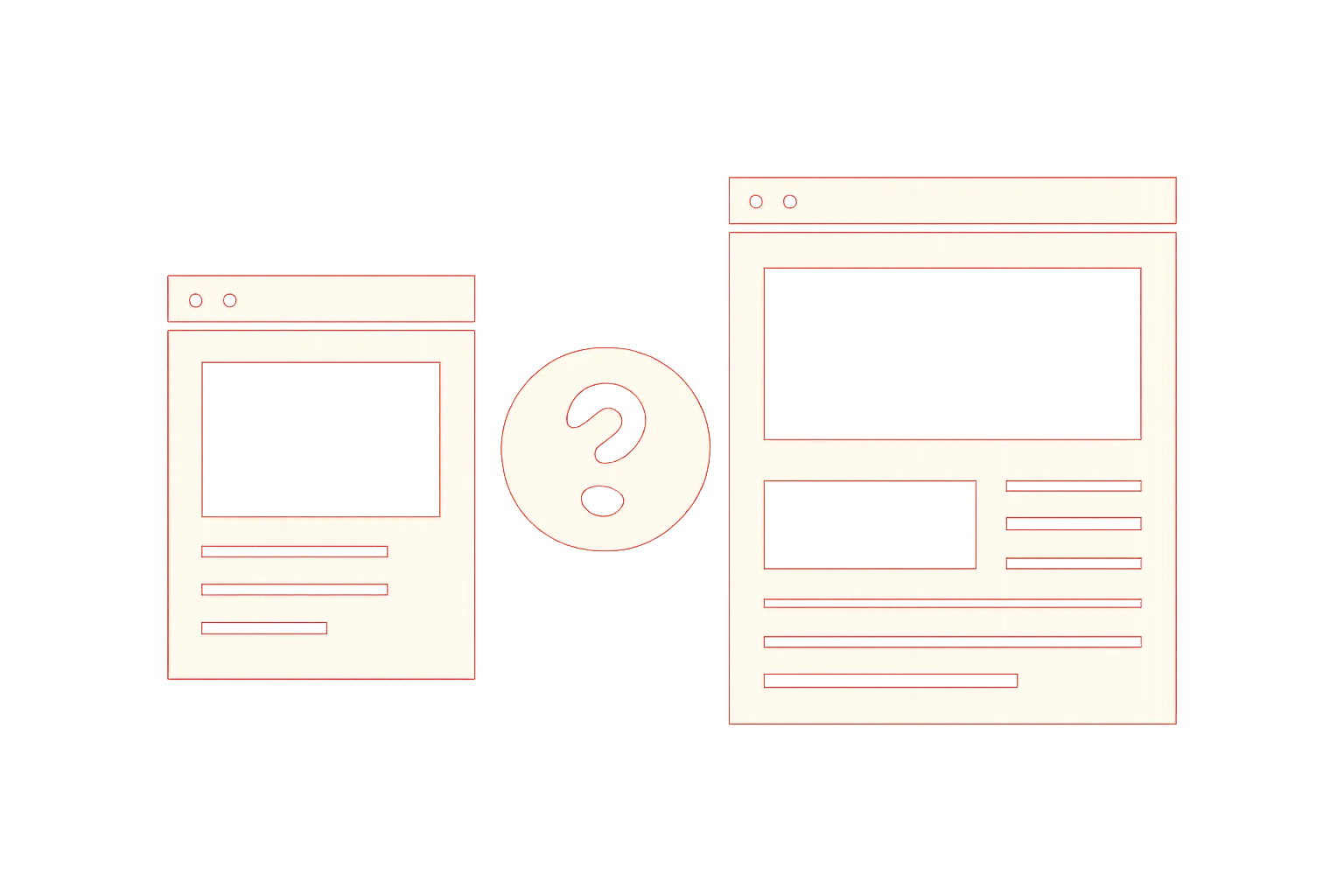
Start with the decision criteria
Before anyone asks should a business choose a landing page or a full website, the real question is simpler: what must the site do on day 1? If the answer is “sell one thing,” the choice is easier. If the answer is “explain several things,” the decision changes fast.
Start with the number of offers. One offer can often live on one page. Three services, two audience types, and a separate support request flow usually push the business toward a full website, because the visitor needs a place to compare, not just a button to click.
Sales process length matters too. A quick impulse purchase can work on a landing page. A longer process, where someone asks a colleague, checks a case study, and comes back two days later, usually needs more pages and more context.
Trust requirements are another filter. A local hair salon and a B2B software company do not ask for the same amount of proof. One may need a single booking path. The other may need team bios, service pages, a portfolio, and a clear explanation of how the work is done.
Traffic intent also changes the answer. Paid traffic aimed at one campaign often fits a landing page well. Organic traffic from search, referrals, and repeat visitors tends to reward a full website, because people arrive with different questions and different levels of readiness.
One more thing: content needs are not optional. If the business needs blog posts, FAQs, pricing notes, support pages, or a structured way to explain services, a landing page becomes cramped quickly. A corporate website is often the cleaner answer here, especially when the business expects the content to grow over time.
When a landing page is the better fit
A landing page works best when the business has one product, one service, one audience, and one clear call to action. That is the classic case. A single campaign for dental whitening, a trial for a software tool, or a one-off event registration can all be handled with one focused page.
The short decision path matters here. If a visitor can decide in 30 seconds, a landing page can do the job. If the visitor needs 30 minutes, the landing page is too thin. Simple as that.
Landing pages also fit businesses that buy paid traffic with a narrow promise. The ad says one thing. The page repeats that same thing. No wandering, no extra branches, no confusion. The visitor lands, reads, and acts. That tight match between ad and page often makes the marketing easier to control.
Some businesses do not need a broad online presence at first. A new service provider may only need calls or form submissions. A consultant may only need booked appointments. A product launch may only need preorders. In those cases, a landing page keeps the message tight and the production work modest.
A landing page can also help when the business is still testing demand. If the team wants to validate one offer before building out a larger site, a single page is a sensible first step. It gives a fast read on interest without forcing the company to prepare ten pages of content that might never be used.
Still, the landing page has one hard limit: it does not like complexity. The more offers, questions, and branches you add, the less it behaves like a landing page and the more it starts to feel like a cramped brochure. That is usually a signal to stop stretching it.
When a full website is the better fit
A full website is safer when the business has multiple services, different audiences, or a sales process that is not finished in one visit. A law firm, medical practice, architecture studio, SaaS company, or investment business often needs several layers of explanation before a contact form makes sense.
Visitors who need to compare and research tend to prefer a full website. They want service pages, an about page, a contact page, and often some form of support content. They may also want proof: case studies, team information, process descriptions, or a small archive of useful articles. A one-page format can feel too thin for that job.
Search visibility is another reason. If the business wants ongoing SEO, a landing page is usually not enough on its own. Search engines and people both respond better when the site has enough pages to cover multiple queries. That does not mean every business needs a massive site on day one, but it does mean a full website is better suited to long-term search work.
Support content matters more than many teams expect. A pricing question, a return policy, a delivery note, or a “how we work” section may save several sales calls. For businesses that answer the same questions weekly, a full website reduces friction and keeps the sales team from repeating the same explanation ten times.
Brand depth also lives better in a full website. A serious buyer may want to know who is behind the business, what the process looks like, and how the service changes for different client types. That is hard to compress into one scrolling page without making the page dense and tiring.
If the business expects expansion, the full website gives room to grow. New services, new locations, or new content categories can be added without rebuilding the whole structure. That flexibility matters more than people admit during the first launch, because growth rarely stays neat.
Side-by-side comparison by business need
| Criterion | Landing page | Full website |
|---|---|---|
| Purpose | One campaign or one offer | Several offers, brand presence, and ongoing content |
| Structure | Single page with a fixed flow | Multiple pages with clear sections |
| Content depth | Short and focused | Detailed, with room for explanation |
| Lead generation | Strong for one action | Strong for several actions and audience types |
| Trust-building | Works for simple offers | Better for high-consideration decisions |
| Flexibility | Limited | Higher |
| Maintenance | Fewer pages to update | More pages, more upkeep |
| Scalability | Weak once the offer expands | Built for growth |
This table is blunt on purpose. A landing page wins on focus. A full website wins on range. If the business has one narrow job, the landing page is often enough. If the business must carry more than one message, the full website stops being a luxury and starts being the practical choice.
For businesses that expect regular content work, the difference becomes even sharper. A site with articles, case studies, and support pages has a structure a landing page cannot really match. That is why teams planning search traffic often think about choosing a CMS early; the content structure affects the build from the start.
The hidden trade-offs businesses often miss
The obvious trade-off is size. The less obvious one is analytics. A landing page gives very clean data for one goal, which is nice. But if the business later wants to measure several user paths, the single-page setup can become awkward, because every click is packed into one long scroll and one narrow flow.
Testing is another hidden cost. A landing page is often easier to test for one headline or one form. Yet once you need to test multiple offers, different audience needs, or several conversion paths, the page can become a mess of competing changes. The result is not insight. It is noise.
Paid traffic efficiency can also shift. A landing page may improve immediate campaign focus, but if the visitor has questions that are not answered, the cost shows up later in support calls or lost leads. A full website may feel less sharp at the ad stage, but it can support the rest of the decision process better.
Content debt is real. If a business starts with a landing page and later needs five service pages, the missing content does not disappear. It simply waits. Rewriting a small site into a larger one can take more time than building the structure properly the first time, especially when the copy, navigation, and page hierarchy all need to change at once.
Future expansion is often where the cheaper choice gets expensive. A business may save time by launching a landing page, then pay for the same structure twice when the offer grows. That second build is not always wasteful, but it is easy to underestimate.
One practical side note: a full website tends to create more ongoing work, including website support after launch. That is not a flaw. It is the price of having more pages, more content, and more points where something can change.
Honest verdict: which should a business choose?
If the business is launching for the first time and has one offer, a landing page is usually the cleaner first move. It keeps the decision narrow and helps the team learn quickly. That matters when the budget is limited and the business needs proof before building more.
If the business has more than one service, a longer sales cycle, or a need to educate visitors, a full website is the better choice. The visitor can explore at their own pace. The business can explain itself properly. Nobody has to force a complicated story into one page and hope for the best.
For limited budgets, the answer is not always “start small.” Sometimes the cheaper option becomes expensive if it is replaced within months. A business with growth plans, multiple leads sources, or a strong SEO goal should think hard before choosing a landing page just because it feels simpler to launch.
For businesses planning to grow beyond a single offer, a full website usually saves trouble later. A service company can add pages for each service. A product company can add documentation, support, and comparisons. A B2B firm can build trust with evidence instead of trying to compress everything into one scroll.
There is a middle case too. A business may begin with a landing page for one campaign, then build a full website after the market response is clear. That can work. But it works best when the landing page is treated as a temporary step, not a permanent home.
For businesses in sensitive sectors, trust can decide the answer by itself. Security, privacy, and credibility matter more when the visitor is about to share personal or financial information. In those cases, even a small site may need support pages and visible safeguards such as website security details.
A simple decision rule for next steps
Use this rule: if one page can answer the visitor’s main question and end with one action, build a landing page. If the visitor needs comparison, proof, background, or several paths to contact you, build a full website. That rule is simple enough to use in a meeting, and strict enough to stop vague arguments.
Then check three points before you start. First, count the offers. Second, map the sales process in steps. Third, list the content you already know you will need. If any of those three keeps growing while you plan, the full website is probably the safer decision.
If the choice is still close, ask one final question: will the site still work after the business changes? A landing page can answer that for a single campaign. A full website answers it for a business that expects the next offer, the next page, and the next round of questions.
For teams that need a practical launch path, the best move is often this: start with the format that matches the current job, leave room for the next 2 or 3 steps, and avoid building a structure that will collapse the moment the business asks for one more service. That is the part people regret later.
